

Lead generation content: How to create blogs that actually generate leads


Then it will be clear once and for all.
And to actually give the ultimate, all-encompassing answer, I also let 7 other SEO fanatics do the talking.
It doesn't get any better, folks.
So check soon:
A landing page is a page you land on from Google, an ad, social media or other platform with the intention of getting someone to convert.
And that conversion could be a hard purchase, calling, scheduling an appointment, or signing up for an e-book, for example.
In addition to intent, the elements that such a page contains are also typical of a landing page. Consider, for example, action buttons, reviews, a clear and crisp design with a focus on conversion and Cialdini's further influence principles.
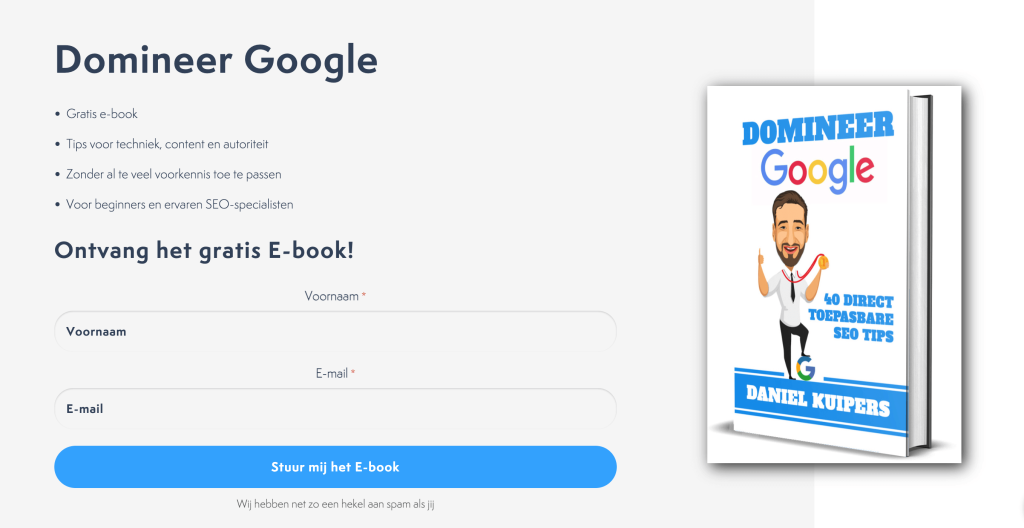
Now, in case you're curious about an example of a typical landing page? Then you should check out the landing page from my e-book "Dominate Google. With that landing page, I currently have a conversion rate of over 34%.
You can find it here.
I want to start with intention. The intent behind a blog is a piece of awareness or, for example, a piece of knowledge transfer. The goal is not an immediate purchase or contact.
So what is the goal? Building or exuding authority and making your target audience wiser.
Other things that are otherwise typical of a blog:
As with the landing page explanation, I want to give you a good example. After all, that is what you are reading right now ;).
Indeed, this is a good example of a blog!

Now that I have given you my views on the two, it is high time to let other people have their say.
After all, not everyone shares the same opinion or gives the same explanation.
I asked five outside SEO specialists and two Online Marketing Agency employees if they would also share their views on this topic.
And I've listed those visions for you. We're going to start with Tom and Nicole, the team leads SEA and CRO at Online Marketing Agency.
Nicole: For me, the difference between a blog and a landing page is in the intent. And thus the result. With a blog, you add value by sharing your knowledge. You inform and inspire. You show your expertise and you build authority in your field. In short, good for the long term.
A landing page is a bit more commercial. It is intended to attract specific visitors to your website for a clear purpose (more sales, quotation requests, etc.). In short, a page that drives visitors to action. And in the ideal scenario, that will bring you business in the short term.
Tom: A landing page is written with the goal of getting the visitor to take an action. Think about requesting a quote or filling out a contact form. A landing page is often a bit more static than a blog.
A blog is written to inform/guide visitors on a topic and is often current and easy to update when there are new developments on the topic. In addition, a blog makes it easier for you to interact with your visitors through the comments.
Clear story, in my opinion! What I like additions are the following terms:
Well I am also curious what the other SEO specialists outside Online Marketing Agency have to say on this topic.
Bart, owner of online marketing agency Click Process, says the following about it:
A blog is meant to provide information and aims to achieve a micro conversion (newsletter subscription, tweet, share, etc.).A landing page is meant to sell and generate a lead.
For that reason, both pages target different keywords and the page structure is completely different.
Hey, other keywords. Good addition! On to the next specialist:
Rutger Steenbergen, owner of SEO Zwolle, goes really deep into it:
In online marketing, I like to look at the sales funnel and Google's see-think-do-care model. People need to see you first (see) and start considering you (think) before hopefully taking action (do). After that, as a business, you want to keep them close to you (care) to get them to buy more often. Blogging is ideal for the do and think phases. Potential customers orient themselves via Google, among others.
In a blog, you don't want to over-sell. You're better off using landing pages for that, which you set up for conversion. Put your salesman's hat on there and convince them that they really need your product or service. And that you are the best party to purchase it. Overall, there are 3 reasons why people don't buy from you. They don't see you, they don't believe you or they don't trust you. Show through your blog that this is unjustified. And through clever landing pages, transform interested people into happy customers. Then the sales funnel will work better and better for you.
Whereas the other specialists and I mainly explained the difference, Rutger also addressed the relationship between the two using a handy model.
We continue with Remon Hendriksen, owner of Internet Impact.
I see a blog as supporting a landing page, which is often your money pages. The landing page is where the most important conversions occur, such as requesting a quote, demo or order. At the same time, these are also generally the most difficult pages to get backlinks for organically. A blog can help here by blogging about topics related to your landing page.
Of course, you then link internally from your blog article to your landing page. I see blogs mainly as a first introduction to your company in which you can entice the visitor in various ways for a micro-action such as clicking through to your landing page, a newsletter subscription or requesting a lead magnet.
Remon also reaffirms what the others have said.What I especially like here is getting backlinks!
On to number 4, Nathan Veenstra of Optimus Online. Nathan has also written a blog on this topic called "What are landing pages and what forms are there?".
A useful article that I recommend you read. In fact, Nathan here explains all the different forms of landing pages and doesn't distinguish so much between a blog and a landing page.
I took the following quote from his blog: A landing page is a specific web page where a visitor enters your website. Whether that's through an online ad, from organic search results or even by typing in a URL directly; in fact, every page on your website is potentially a landing page. Yet that is not always what is meant when someone talks about a landing page. Indeed, often just not. - Nathan Veenstra
On to the last SEO specialist: Martijn van Tongeren, co-owner of IMU.
A landing page is meant to convert a visitor to a specific goal. A blog post is intended to inform a visitor. In both cases, the visitor is in a different part of the customer journey and thus will look something up in Google with a different intention.
If I search on "seo course," my intention is that I want to take a course in SEO. If I search on "what is seo" or "seo trends 2020," I am looking for information about SEO. So before optimizing, make sure you know what type of visitor you are writing your page/blog for.
Martijn makes it nice and concrete and gives some helpful examples. An addition that completes the previous opinions!
If all goes well, the difference between a landing page and a blog is now completely clear!
In addition to my own views, I also gave the floor to 7 specialists who each shared their own insights. In short, plenty of input to make your content strategy even better.
It's now up to you to turn this knowledge into action and get to work writing landing pages and blogs.
Absolutely. In fact, they are a top combination. A blog can nicely pave the way for a landing page by first informing visitors and then directing them to a place where they can take action, such as requesting a quote. So smart linking!
Simple: look at your intent. Do you want someone to do something immediately, like buy or sign up? Then go for a landing page. Do you primarily want to share value and showcase your expertise? Then a blog is the best choice.
Blogs are often a bit longer because you can go deeper into a topic. A landing page? That should be short and sweet, with no fuss. You want to lead the visitor to that conversion as quickly as possible.
Can certainly be done, but with a different approach. A landing page aims to convince, so you throw in reviews, product details and other info to gain trust. But always with one goal: action!


Written by: Daniël Kuipers
Daniel is the founder of Online Marketing Agency. He constantly scours the Internet for the latest gadgets and tactics and blogs about them in understandable language. Well, sometimes.