

Please note: Starting August 17, 2026, Google will be changing how smart bidding strategies work


The CTR, is a much-discussed factor within online marketing. It shows how well your ads are working and it has a direct impact on the success of your campaigns. But what can you do to increase your CTR? In this blog, I'll give you 5 tips on how to do just that. But first, a brief explanation of what exactly CTR means.
The CTR is the ratio of the number of times your ad is displayed and the number of times it is clicked on. The resulting percentage gives a clear picture of how effective your ad is.
A high CTR is a sign that your ad is relevant and well-suited to the needs of your target audience.
Now that you know what the CTR is, you should also be able to calculate it.
Suppose your ad has 1,000 impressions and 200 people click on it, then your CTR is 20% (clicks / impressions x 100%).
A high CTR means your ad is relevant and connects with your target audience. But it goes further. Google uses the CTR to determine the quality score of your ads. A higher quality score leads to lower cost per click and more return.
In other words, a better CTR saves you money AND delivers more.
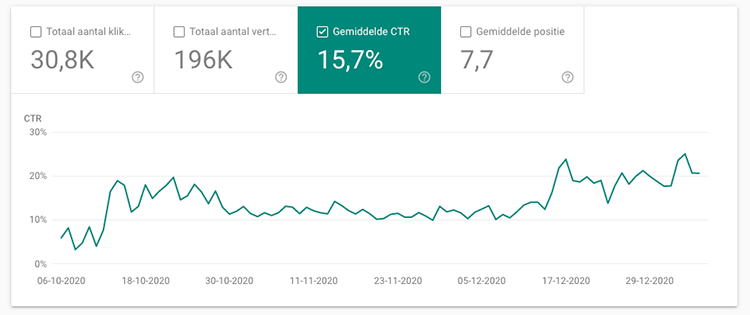
The CTR is very influential for ads because it shows how well they perform. The higher the CTR, the more people will click through to your website from that ad.
If the CTR is low, then you can assume that the quality and/or relevance of your ad is on the low side. This could mean:
Before you start optimizing the CTR, you obviously need to know at what level within Google Ads to do so. After all, you can analyze the CTR in several ways:
My advice is to look primarily at the keyword level and your ad level. After all, you can optimize and adjust those directly. Is your CTR on a keyword low? Then it could be that your ad text does not sufficiently match the keyword.
Then also compare the CTR of your different campaigns to find out what your best performing ads are. After all, you always want to keep those running and replace the poorly performing ads.
Just as multiple roads lead to Rome, multiple roads lead to a better CTR. And 5 of those paths we will now go through.
Put the most important keyword in your ad, preferably in the title and description. This makes your ad more relevant to the user, but beware of over-optimization. An ad that feels unnatural may be rejected by Google.
Ad extensions increase the visibility of your ad and allow you to share additional information. Think of location extensions, sitelinks or a call-out. These additional elements grab your target audience 's attention and increase the likelihood that they will click through.
Test different ad types. In addition to expanded text ads, you can also try out responsive text ads. Here is a brief explanation of both types.
With extended text ads, you can specify up to 3 titles and 2 descriptions. These are displayed in fixed order, giving you complete control over how your ad looks.
In doing so, you provide up to 15 titles and 4 descriptions. Google's algorithm then automatically creates different combinations that can be unique for each user. This can theoretically increase CTR, but it is not a guarantee!
Use optimized ad rotation if you deploy multiple ads per ad group (which I definitely recommend). With this setting, Google determines which ad they will see for each user. Instead of showing ads without any strategy, use Google's algorithm to determine which ad is displayed per user, which can increase the chances of a better CTR. But again, this is not guaranteed.
Write catchy ad copy, in which the message is clear, matches the needs of your target audience and always has a clear call-to-action. Maybe a bit of a lame tip, but I see that ad copy is often written for the search engine and not for the customers themselves. In addition, use Cialdini's principles, such as scarcity. That way you can entice users to click.
You need to keep monitoring ads to make sure your campaigns continue to perform optimally. It's great when an ad works well, but performance is not set in cement. Factors such as competition, search trends and customer behavior are constantly changing, so your ad results can fluctuate. By monitoring regularly, you can optimize your budget and maintain competitive advantage.
Regular monitoring keeps your campaigns up to date and ensures that your investment in ads is getting the highest return.
Your ads can almost always get better, in fact as we would say, "it can get a little better every day.





Written by: Daniël Kuipers
Daniel is the founder of Online Marketing Agency. He constantly scours the Internet for the latest gadgets and tactics and blogs about them in understandable language. Well, sometimes.